
Integrated UF System
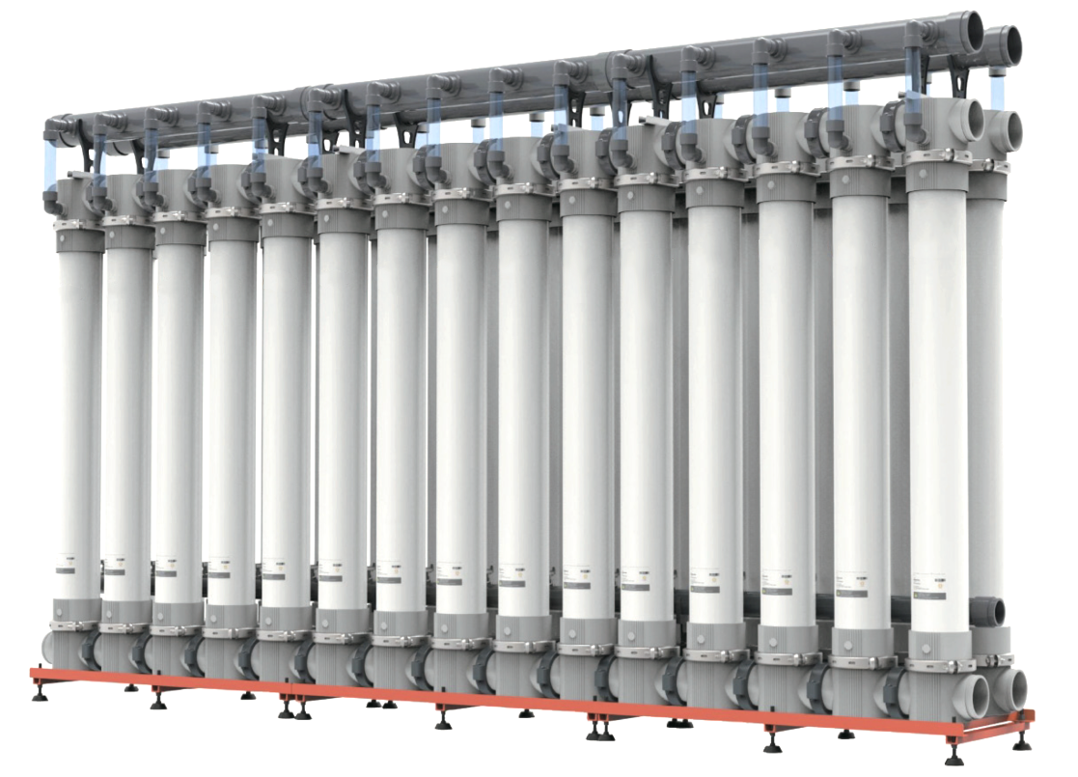
Compact modular prefab ultrafiltration rack using large modules configured in a small footprint (80 sqm effective area) using TIPS (Thermally Induced Phase Separation) fiber, provide an advanced solution for large scale applications such as drinking water purification or seawater desalination pretreatment. For fast and easy installation to expand capacity or replacement of existing UF modules.
Characteristics and Advantages
High-product quality
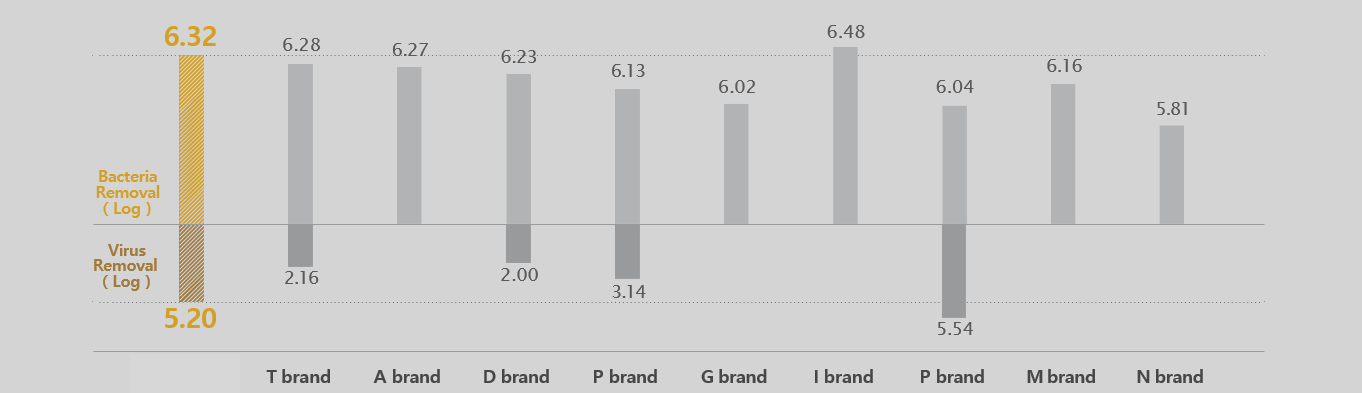
TIPS UF membrane High bacterial and virus intercept rate Water quality guaranteed
Compact system
Large modules of 80 m2 effective area Lower transport cost Shorter installation time
Modularized System
Easy to increase capacity
Easy installation
Rapid hookup UF rack reliable Easy to assemble
Specifications - 80m² per module
| NO. | MODULE QTY | QTY PER ROW | LENGTH (mm) | TOTAL AREA (m²) | DRY WEIGHT (kg) | WET WEIGHT (kg) |
|---|---|---|---|---|---|---|
| IC-P80-01021 | 10 | 5 | 1720 | 800 | 1200 | 1200 |
| IC-P80-02021 | 20 | 10 | 3420 | 1600 | 2400 | 2400 |
| IC-P80-03021 | 30 | 15 | 5130 | 2400 | 3600 | 3600 |
| IC-P80-04041 | 40 | 10 | 3420 | 3200 | 4800 | 4800 |
| IC-P80-06041 | 60 | 15 | 5130 | 4800 | 7200 | 7200 |
| IC-P80-08042 | 80 | 20 | 6840 | 6400 | 9600 | 9600 |
| IC-P80-10042 | 100 | 25 | 8550 | 8000 | 12000 | 12000 |
| IC-P80-12042 | 120 | 30 | 10260 | 9600 | 14400 | 14400 |
Operating Conditions
| Temperature (°C) | 1-20 |
|---|---|
| pH range (continuous) | 1-11 |
| Max NACIO tolerance (ppm) | 5,000 |
| pH range (CIP) | 1-14 |
| Recommended TMP (MPa) | 40-120 |
| Backwash flux (L/(m²•h)) | 0.02-0.15 |
| Aor scour flow (Nm³/h•Module) | 70-120 |
| Max air inlet pressure (MPa) | 0.2 |
| Max feed pressure (MPa) | 0.2 |
| Max TMP (MPa) | 0.3 |
| Max backwash pressure (MPa) | 0.25 |
| Turbidity (NTU) | ≤0.1 |
| Fliterated Water | ≤3.0 |
THERMALLY INDUCED
PHASE SEPARATION (TIPS)
PVDF Membranes
ln recent years, the large majority of ultrafiltration membrane manufacturers have adopted polyvinylidene fluoride (PVDF) as the polymer of choice for creating hollow fiber membranes for demanding water applications. The requirements for high flux rates, appropriate pore size, reliable membrane integrity, mechanical strength and durability, cleaning chemical compatibility, and relatively low cost, have made PVDF the choice over other polymers such as PAN, PES, and alternative materials such as ceramic membranes.
While not commonly known in the industry, there are two basic methods for manufacturing PVDF membranes that result in significantly different end-products: Thermally lnduced Phase Separation (TIPS)and Non-solvent lnduced Phase Separation (NIPS).
TIPS PVDF MEMBRANES
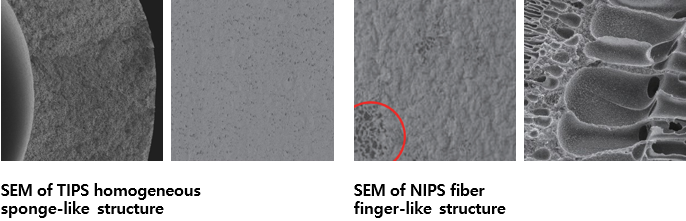
Earth Lab patented Thermally Induced Phase Separation (TIPS) manufacturing technique delivers the strongest, most chemically resistant, and highly permeable membrane in the industry. The TIPS PVDF membranes exhibit isotropic characteristics, ensuring uniform mechanical properties in all positions and across their entire depth. This imparts a superior level of integrity and durability, setting them apart from other membranes available in the market.
 (500 x 500 px) (600 x 100 px) (300 x 100 px).png)
SEM of TIPS fiber. Note the isotropic structure
NIPS PVDF MEMBRANES
NIPS membranes display anisotropic characteristics, meaning their mechanical properties vary according to positions. Featuring a “skinned” structure, these membranes possess tightly configured inner and outer surface pores, typically rated between 0.02 µm and 0.04 µm. Supported by a channeled structure, lacking filtration capability, NIPS membranes are prone to higher rates of fiber breakage and demonstrate lower resistance to cleaning chemicals.
 (500 x 500 px) (600 x 100 px) (300 x 100 px) (1).png)
SEM of NIPS membrane. Note the 'finger' structure.
MANUFACTURING METHODS
Hollow Fiber Spinning-TIPS
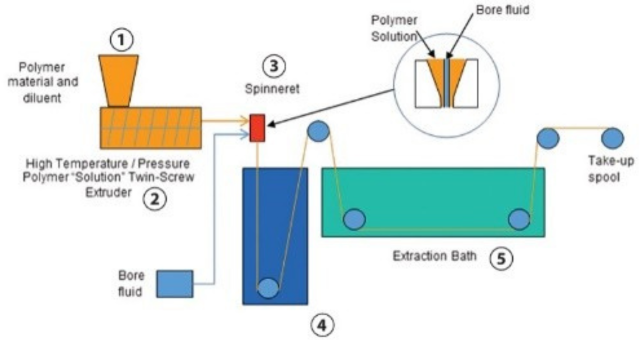
(1) Blend PVDF polymer with a low molecular weight diluent in solid form. (2) Utilize a twin-screw extruder to pressurize the mixture and elevate the temperature beyond 200°C, resulting in a homogeneous liquid solution. (3) Pass the solution through the spinneret to shape the hollow fiber. (4) Subsequently, cool and solidify the fiber in a water bath. (5) Dissolve and extract diluents using alcohol to create uniform pores in the fibers. Finally, both the solvent and diluent are recycled.
Hollow Fiber Spinning-NIPS
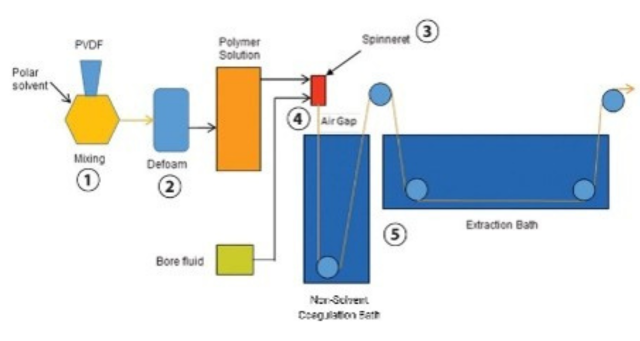
(1) Blend PVDF polymer with a low molecular weight diluent in solid form. (2) Utilize a twin-screw extruder to pressurize the mixture and elevate the temperature beyond 200°C, resulting in a homogeneous liquid solution. (3) Pass the solution through the spinneret to shape the hollow fiber. (4) Subsequently, cool and solidify the fiber in a water bath. (5) Dissolve and extract diluents using alcohol to create uniform pores in the fibers. Finally, both the solvent and diluent are recycled.
TIPS provides a stronger protection for PVDF fiber’s molecular structure than NIPS does. NIPS uses solvent which changes the molecular structure and creates a double bond (reduction state), making the fiber sensitive to chemical concentration
 (500 x 500 px) (600 x 100 px) (300 x 100 px) (100 x 100 px) (100 x 41 px) (1).png)
Molecular structure of TIPS fiber(left) and NIPS fiber(right)
Earth Lab TIPS techology a patented PVD hollow fiber membrane manufacturing technique originated from the research efforts of scientists at the esteemed Tsinghua University. In contrast to NIPS Earth Lab TIPS technology endows the membrane with a homogeneous sponge-like structure, increased cross-linkages, and interconnected pores, offering diverse pathways for water cleaning chemicals. Consequently, compared to NIPS vulnerable skin with underlying finger-likestructure, TIPS membranes exhibit higher permeability,heightened mechanical strength, superior cleaning efficiency.
| PARAMETER | Earth lab TIPS | Typical TIPS |
|---|---|---|
| Pure Water Flux | 12 LMH/kPa | 2 - 5 LMH/kPa |
| NaOCI Tolerance during CIP | 5,000 mg/L | 2,000 mg/L |
| pH range during CIP | 1-13 | 2 - 11 |
| Tensile Strength | 5.3 MPa | 3.6 - 4 MPa |
| Fouling Rate¹ | 1.1kPa/min | 2.8 - 5.4 kPa/min |
| PermeateSDI15 | ≤3.0 | ≤ 3.0 |
| Permeate Turbidity( NTU) | ≤0.1 | ≤ 0.1 |
¹Note: Indicates relative fouling rate under identical row water and flux conditions within one minute.
Leveraging cutting-edge technology, Earth Lab can provide high-quality products, including (1) conventional products such as pressurized and submerged series, (2) retrofit series, as well as (3) integrated systems.